
LiteBlue eReassign Transfer
LiteBlue eReassign is a USPS employee tool for requesting a voluntary transfer or reassignment to another postal installation. If you are planning to relocate, move to another USPS facility, or explore an eligible opportunity in another craft, the system allows you to submit transfer requests online, select your preferred locations, track your request’s progress, and manage active requests without relying entirely on paperwork.
But it is not a regular USPS job board. You usually request a reassignment to another installation or bid cluster, not simply apply for a specific job shown on the screen. Your employee status, craft, career service, destination, qualifications, seniority, available vacancies, and staffing requirements can all affect the outcome.
What Is LiteBlue eReassign?
eReassign USPS is part of the employee self-service environment available through LiteBlue. It was created to make voluntary reassignment requests easier to submit and track electronically.
You can use the system to manage several parts of the transfer process, including:
A submitted request is only the beginning of the process. It does not guarantee that USPS will transfer you or that a particular assignment will become available.
How to Login LiteBlue eReassign?
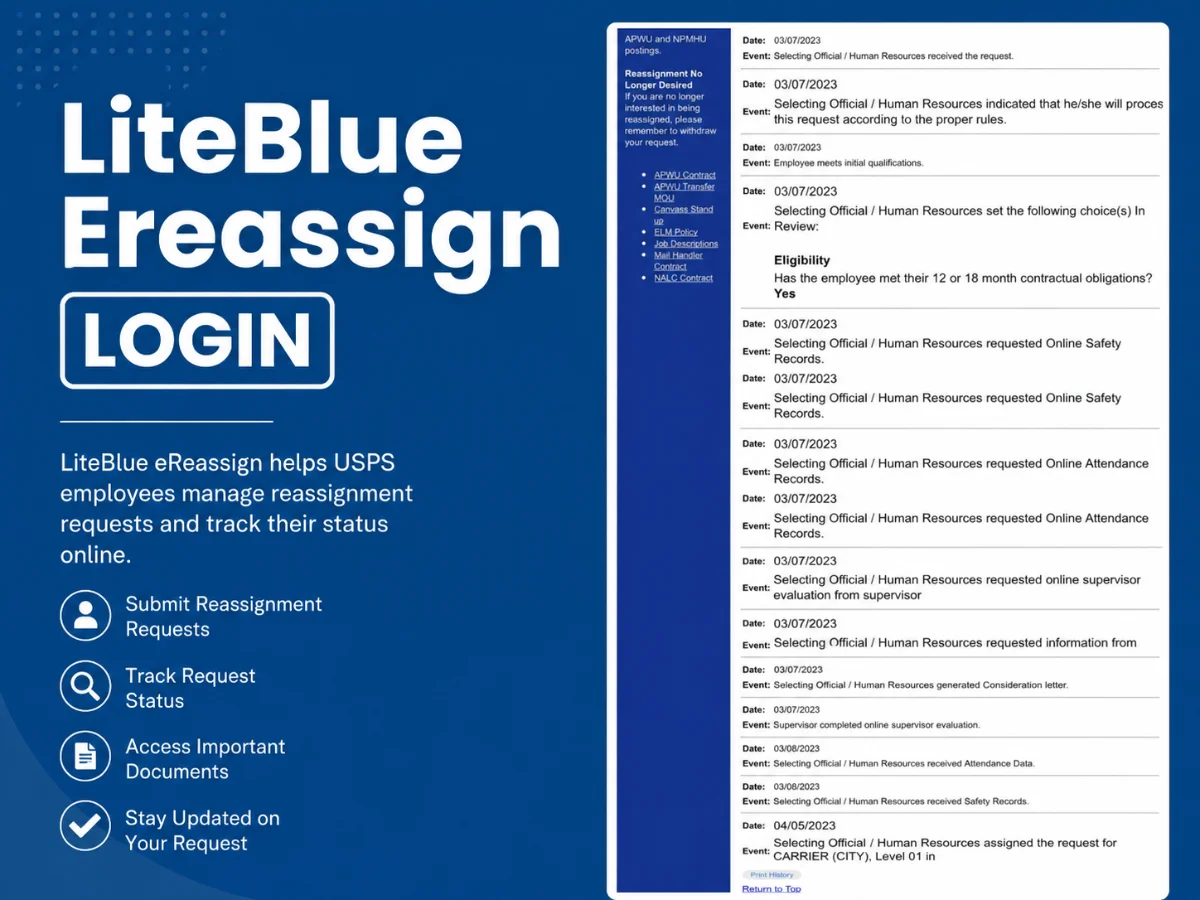
Reassignment at USPS
A reassignment generally involves permanently moving an employee to another eligible position or installation under the applicable staffing rules.
For example, you may currently be a career USPS employee in one state and want to relocate to another. Instead of resigning and applying to USPS again as an outside applicant, an eligible reassignment may allow you to request movement within the Postal Service.
The exact effect of the move depends on whether you are staying in the same craft, changing crafts, moving between installations, or participating in a special reassignment program.
Eligibility
Regular eReassign is mainly designed for eligible career bargaining-unit employees. However, eligibility is not identical for every USPS employee. Your options can depend on whether you are a:
Some non-career employees can see or use specific eReassign features, particularly certain canvass opportunities, even though they do not qualify for the standard career transfer process.
Career Employees
Career bargaining-unit employees are the primary users of regular eReassign. You still need to meet the service, craft, qualification, and destination requirements that apply to the transfer. Becoming a career employee does not always make you immediately eligible to transfer.
City Carrier Assistants
A CCA normally does not use regular eReassign in the same way as a career city carrier. After conversion to career status, the employee may need to complete the required period of career service at the current installation before becoming eligible for a voluntary transfer.
Time worked as a CCA should not automatically be treated as career service toward the regular transfer lock-in requirement.
Postal Support Employees
PSEs generally do not participate in regular career eReassign transfers. However, eligible PSEs may use eReassign for certain 50-mile canvass opportunities. This is a separate process with its own eligibility and selection rules.
Part-Time Flexible Employees
PTFs can have access to regular or special reassignment opportunities depending on their craft. For example, eligible Clerk Craft PTFs can participate in regular eReassign and may also see certain canvass or residual vacancy opportunities.
Mail Handler Assistants
Eligible MHAs can participate in certain special canvass opportunities. These should not be confused with the standard career employee transfer process.
Mail Handler Assistants
Rural carrier movement is handled differently from the normal city carrier, clerk, or mail handler transfer process. If you are a rural carrier, check the rules specifically applicable to the Rural Carrier Craft, including mutual exchange procedures where relevant. Do not assume that a transfer rule for city carriers also applies to you.
Transfer Eligibility and Lock-In Periods
One of the first things to check before submitting a request is how long you have worked as a career employee in your current installation. Two periods commonly associated with regular USPS transfers are 12 months and 18 months.
12-Month Transfer Requirement
A 12-month career-service requirement generally applies to certain transfers outside the local geographical area.
This means you may need at least 12 months of career service in your present installation before becoming eligible to request that type of reassignment.
18-Month Transfer Requirement
An 18-month requirement can apply to certain local transfers, including movement within the same district or to an adjacent district.
The exact requirement depends on your craft and circumstances, so the 12- and 18-month periods should not be treated as universal rules for every USPS transfer.
Submitting Before Your Eligibility Date
Submitting an eReassign request before you meet the required service period does not necessarily reserve your place in line.
An ineligible request can be removed from consideration, and you will need to submit another application once you become eligible. Before applying, confirm your:
Career start date → Current installation → Destination → Applicable service requirement → Eligibility date
This avoids waiting on a request that cannot be processed.
Exceptions to the Lock-In Period
Certain situations can have different requirements or exceptions. These may include returning to a former installation, specific part-time employee situations, or an early release allowed under applicable transfer provisions.
Special reassignment programs can also have eligibility rules that differ from regular eReassign.
Creating an eReassign Request
Once you have confirmed your eligibility, you can start searching for potential destinations.
Destination Search
eReassign can help you find eligible postal installations and crafts. Search options can include information such as:
You do not necessarily need to wait until you see a specific vacancy before expressing interest in a destination. A location appearing in the system also does not guarantee that a job is immediately open.
Selecting an Installation and Craft
Pay close attention to both the installation and craft. A USPS installation is not always the same thing as a single retail post office building. It can represent an organizational unit containing multiple assignments or work locations.
You may also encounter the term bid cluster, which refers to assignments or locations grouped together under the applicable bidding and staffing structure. For that reason, think of regular eReassign as:
Requesting consideration for transfer into an installation or bid cluster
rather than:
Applying for one exact job at one building.
Submitting the Request
Review your selections carefully before submitting. Once the request is submitted, save important details such as:
The original submission date can become particularly important when multiple employees are waiting for the same destination.
Request Duration and Renewal
A regular eReassign application generally remains active for 12 months from the submission date, unless it is reached for review or otherwise closed earlier. It means eReassign is not a system where you submit an application once and leave it indefinitely.
Renewal Period
An active request can generally be extended before its 12-month expiration, per the renewal instructions in eReassign.
For applicable requests, the renewal window may become available up to approximately 90 days before expiration. Keep track of the date rather than assuming the system will automatically preserve your request.
Importance of the Original Request Date
Transfer requests can be considered in the order they were received. Suppose you have been waiting for a location for nearly a year. If you allow the request to expire and then submit another application, the new application can receive a newer submission date. That can move you behind employees who submitted their requests earlier.
For this reason, renewing an eligible request is usually better than allowing it to expire and starting over when you still want the same transfer.
Multiple Active Requests
Depending on the applicable process, you may be able to maintain requests for multiple destinations. An individual request can also include multiple office or position preferences within the permitted structure.
This can be useful if relocation is more important to you than reaching one particular installation. Once you accept and report under a completed transfer, other active transfer requests may be closed.
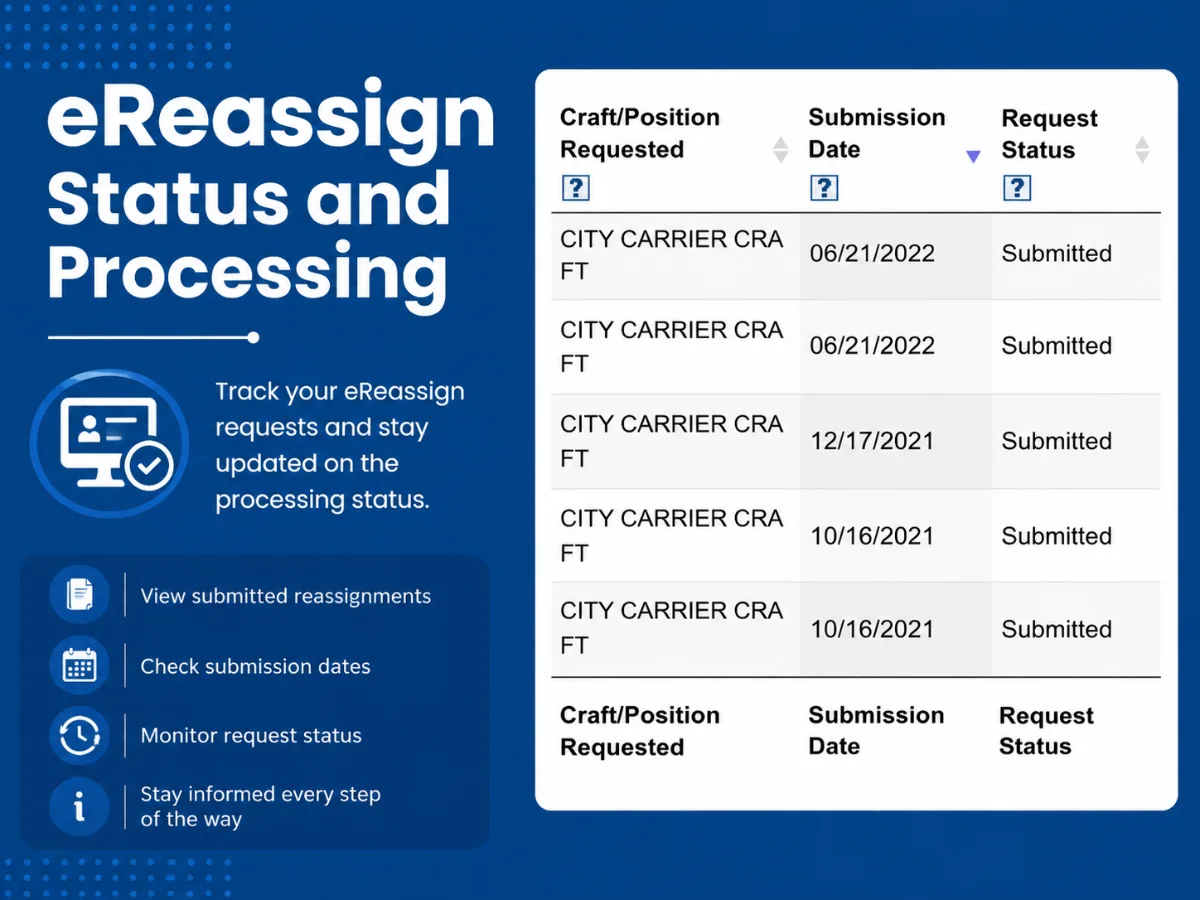
eReassign Status and Processing
After submitting a request, you can monitor its progress inside eReassign. Two important statuses are On Hold and In Review.
On Hold
An On Hold status generally means your request is active and waiting for the appropriate opportunity or stage of consideration. It does not mean your application has automatically been rejected. You could remain On Hold because:
An On Hold request can remain unchanged for months, especially for a popular destination.
In Review
In Review generally means your request has progressed and is actively being evaluated. At this stage, USPS may examine the information relevant to the transfer, including your eligibility and qualifications. The review can include factors such as:
Moving from On Hold to In Review is therefore a meaningful change in the process, but it still does not guarantee final approval.
Work, Attendance, Safety and Qualifications
A transfer request is not evaluated only by its submission date. Your employment record and ability to perform the duties of the position can also matter.
Work Record
Your overall work record can be considered when determining whether you are suitable for the reassignment.
Attendance Record
Attendance can be part of the transfer review. It does not mean that a single number, such as your unused sick leave balance, automatically determines whether you qualify. Your record should be considered in context under the rules that apply to your transfer.
Safety Record
Safety can also be considered for applicable transfers, particularly when the new position involves driving, equipment, or other safety-related responsibilities.
Some specialized craft procedures use different selection criteria, so the exact role of attendance and safety can depend on the position being filled.
Minimum Qualifications
You must meet the qualifications required for the position. A transfer request cannot automatically place you into a job for which you do not qualify. Depending on the assignment, qualifications can involve:
Cross-craft moves can involve additional qualification requirements.
Vacancies and the Transfer Queue
One of the biggest misconceptions about eReassign is that every location shown represents an open job. It does not. Regular eReassign is fundamentally a transfer request system, not a standard vacancy board.
No Immediate Vacancy Required
You can have an active installation request even when no suitable vacancy is available at that moment. If an appropriate opportunity becomes available later, employees with active requests can enter the consideration process. Submitting early can therefore matter.
Order of Requests
When multiple eligible employees want the same destination, the date of the request can influence the order in which they are considered.
This is why repeatedly withdrawing and resubmitting a request without a reason can work against you.
High-Demand Destinations
Some cities and installations attract far more transfer requests than others. A location with:
Many applicants + Few transfer opportunities
can produce a very long wait. Another installation may process requests much faster simply because fewer employees are trying to move there. There is no single eReassign waiting time that applies nationwide.
Staffing Rules and Transfer Ratios
A vacancy does not automatically become an eReassign transfer opportunity. USPS may have to fill positions according to a specific staffing order. Depending on the craft and situation, that process can:
Transfer Ratios
Certain Clerk Craft processes use transfer-to-conversion ratios. For example, some offices use a 1-in-4 structure, while smaller offices can use a 1-in-6 structure for applicable opportunities.
That means an available position does not automatically go to an outside transfer applicant simply because someone is waiting in eReassign.
Residual Vacancies
A residual vacancy is generally an assignment that remains open after the applicable internal staffing or bidding processes are complete. Residual vacancies can then enter other staffing procedures, including certain reassignment processes.
Understanding this distinction helps explain why you may know that an office needs employees while your eReassign request remains On Hold.
Cross-Craft Reassignment
eReassign can also become relevant when an eligible employee wants to move from one craft to another. A cross-craft reassignment is more complicated than moving between installations within the same craft. The move can affect:
The receiving craft’s rules become particularly important. For example, an employee moving into a Maintenance position may face different qualification and selection procedures from someone transferring into a Clerk Craft position.
A cross-craft move should therefore be evaluated as both a location change and a career change.
Reassignment Within the Same Installation
Not every move within USPS belongs in regular eReassign. If you want to change crafts while staying in the same installation, another procedure may apply, such as submitting a written request to the installation head. Before opening eReassign, identify what you are actually trying to do:
Desired Move | Typical Process |
|---|---|
Another installation | eReassign may apply |
Same installation, different assignment | Internal bidding or another procedure may apply |
Same installation, different craft | Separate craft-change procedure may apply |
Posted career position | eCareer may apply |
Specific bid assignment | eJobBidding may apply |
Choosing the correct system prevents you from waiting on a request that does not match your goal.
50-Mile Canvass Opportunities
The 50-mile canvass is a special process available to certain employees through eReassign. It should not be confused with a regular transfer request.
Eligible opportunities can be shown to employees within a 50-mile radius of the installation where the vacancy is located. Depending on the applicable Clerk Craft process, participants can include:
Certain Mail Handler opportunities can also involve eligible employees under their own procedures.
Canvass Posting Schedule
The established eReassign canvass process generally makes postings available on the:
1st of the mont and 15th of the month
A canvass generally remains open for around 10 days. Eligible employees can access the My 50-Mile Canvass area to see available opportunities.
Canvass Selection
A canvass does not operate exactly like a regular transfer queue. Selection can use:
For Clerk Craft canvasses involving PTFs and PSEs, eligible PTF applicants are considered based on installation seniority, followed by PSE applicants based on relative standing.
Canvass Request Limits
Special rules can limit participation during a posting period. For example, an employee may be limited to one 50-mile canvass request per posting period, and successful placement can trigger a period during which another canvass transfer is not available.
Post-Canvass Lock-In
An employee successfully placed through an applicable canvass generally has to remain in the new bid cluster for 12 months from the placement date.
Canvass Withdrawal
If you change your mind, use the withdrawal process shown in eReassign. Do not assume that you can wait until the reassignment date and simply decline without consequences. Special canvass opportunities can have specific withdrawal deadlines.
PTF Reassignment Opportunities
Part-Time Flexible employees can have access to reassignment opportunities beyond the ordinary transfer queue. Depending on the craft and current program, PTF employees may be able to pursue:
These programs can lead to placement in another installation or, in some cases, an available full-time assignment. Always read the specific posting, as a special PTF opportunity may use different rules than your normal eReassign request.
Seniority After a Transfer
Seniority deserves careful attention before accepting any reassignment. Moving to another installation can result in a new seniority date under the rules governing the transfer. Changing crafts can have an even greater effect. Your new seniority can influence:
A transfer that looks attractive geographically may therefore have long-term career consequences. Before accepting, determine exactly how the move will affect your seniority.
Pay and Position After Reassignment
Do not assume that your current pay, assignment, schedule, and employment conditions will remain identical after a transfer. A cross-craft reassignment can place you into the pay level associated with the new position. Review the following before accepting an offer:
The details matter just as much as the destination.
PTF Status After a Transfer
Some transfer processes can result in an employee entering the new installation as a Part-Time Flexible employee rather than immediately receiving a full-time regular assignment.
Therefore, “transfer approved” should never automatically be interpreted as “same status, same schedule, different city.” Read the actual reassignment offer before making relocation plans.
Reporting to the New Installation
Once a transfer has been approved and accepted, the losing and gaining installations coordinate the employee’s release and reporting date. The waiting period after acceptance is different from the time you spent waiting in the eReassign queue.
A reasonable reporting period can involve advance notice to your current installation and time to prepare for the move. In many regular transfer situations, the process requires at least 30 days’ notice, with longer periods possible depending on the circumstances.
This creates two separate timelines:
Transfer queue: Submit → Wait → Review → Approval
Transfer completion: Accept → Release → Reporting date → New installation
The first can take months or longer. The second normally happens within a more defined period.
Relocation Costs
A voluntary USPS reassignment does not automatically mean USPS will pay your moving expenses. For many voluntary bargaining-unit transfers, the employee is responsible for relocation costs. Before accepting a distant transfer, calculate expenses such as:
A transfer may make sense professionally but still require significant personal relocation expenses.
Withdrawing an eReassign Request
An active regular request can generally be withdrawn before completion. You should withdraw a destination if you know you no longer want to move there.
However, do not repeatedly withdraw and resubmit the same destination without considering the effect on your request date. A fresh application can put you behind employees who maintained older requests.
Special canvass opportunities may have separate withdrawal rules, so always check the instructions for that posting.
Transfer Denials
An USPS LiteBlue eReassign request can be denied. Possible issues can include:
If you believe a denial was handled incorrectly, save all documentation related to your request and discuss the decision with the appropriate union representative. Useful records include:
A transfer denial can be subject to the applicable grievance process, depending on the circumstances.
Availability and Maintenance
eReassign can occasionally be unavailable because of maintenance. The system has historically had a routine maintenance window around:
Friday midnight through early Saturday morning, Central Time.
Broader LiteBlue maintenance can also temporarily affect eReassign and other HR applications. If the system is unavailable, check again later before assuming that your request has disappeared.
eReassign vs. eCareer vs. eJobBidding
These three USPS systems are frequently confused.
USPS System | Primary Purpose |
|---|---|
eReassign | Request transfer or reassignment to another installation |
Apply for posted USPS career opportunities | |
eJobBidding | Bid on eligible USPS assignments |
Other LiteBlue applications serve completely different purposes. ePayroll provides payroll information; eOPF relates to personnel records; eRetire supports retirement-related services; and PostalEASE handles eligible benefits and employee transactions.

Conclusion
LiteBlue eReassign allows eligible USPS employees to request a voluntary transfer, but approval depends on factors such as career status, craft, seniority, destination, vacancies, qualifications, staffing needs, and the request date.
To improve your chances, confirm eligibility, submit the correct request, track its expiration and status, and understand how withdrawing an existing request may affect your position. If you receive an offer, review the new position, pay, schedule, seniority, employment status, reporting date, and any transfer lock-in period before accepting.